Selected case studies
v2.1 · August 2026
Antibody Design and Engineering with Abtique: Case Studies from our Partner Labs
Validation studies for research teams considering computational solutions that leverage A.I. in both antibody and nanobody discovery or engineering projects.
At Abtique, we design antibodies computationally from the target’s sequence and structure; partner and client laboratories synthesize, express and test the panels. This document reports what they measured, target by target, with each criterion and denominator stated.
Platform track record to date
143
design rounds delivered
42
distinct targets across broad disease areas
63
partner campaigns since 2019
2 wks
spec lock to delivery
11 of the last 12 campaigns had at least one candidate which met or exceeded each partner’s predefined KD or functional threshold. Formats include scFv, VHH, VHH-Fc and IgG with work serving Fv design in CAR, BiTE and bispecific formats.
Key outcomes
Sub-nanomolar affinity (scFv):
20 candidates against a chemokine receptor for a BiTE molecule at KD ≤ 100 nM by SPR, including 3 at < 10 nM and a best of 0.84 nM KD.
20 candidates against a chemokine receptor for a BiTE molecule at KD ≤ 100 nM by SPR, including 3 at < 10 nM and a best of 0.84 nM KD.
Specificity rescue (IgG):
Parent clone bound weakly and non-specifically; 3 of 20 designs bound monospecifically at KD ≤ 100 nM in one round.
Parent clone bound weakly and non-specifically; 3 of 20 designs bound monospecifically at KD ≤ 100 nM in one round.
First-round hits (IgG, VHH-Fc):
Several partners reached KD ≤ 100 nM or functional binders in a single round, including a 12-design panel that returned 2 functional binders with no prior structure.
Several partners reached KD ≤ 100 nM or functional binders in a single round, including a 12-design panel that returned 2 functional binders with no prior structure.
1
What we do
De novo design. From the target’s structure and epitope hypotheses, with 106–108 variants screened per round using state-of-the-art A.I. methods coupled with HyperBind2.
Engineering / affinity maturation. From a parental sequence with binding assay readouts, we propose substitutions to improve KD, specificity, and optimize developability.
Gold-standard methods. Every delivered design clears molecular docking and all-atom interface analysis before delivery, with transparent reporting on the computational pipeline and validation methods behind it.
Lab-to-A.I. Feedback. We optimize directly on any assay, including cell-based functional readouts, not just binding data. Each round converts 96 isolated outcomes into ~10⁴ labeled contrasts, so HyperBind2 improves round over round.
Our guarantee
If no sequence meets the agreed criterion at spec lock after you have run and shared complete assay data for three rounds, we will run up to two additional design rounds for that target and format at no design cost, using your data as feedback. Assay execution and wet-lab costs remain the responsibility of your team or CRO.
Third-party perspective
“I’ve been working in protein design for more than 20 years, and this is one of the most remarkable examples of antibody-to-target design I’ve seen in my career.”
Prof. Salvador Ventura, Chair Professor of Biochemistry and Molecular Biology, Institute of Biotechnology and Biomedicine, Universitat Autònoma de Barcelona
Is this a fit for your program?
Good fit if you can synthesize 12–96 constructs and run binding or functional assays, in-house or with a CRO.
Best fit if you commit to the loop. Hard programs take multiple rounds, and each round of data, failures included, is what sharpens the next.
Not a fit for yeast display or cell-free systems, small-molecule targets, manufacturing-only optimization, or no assay capacity. Designs are optimized for mammalian cell-based expression.
Our view
AI alone is not a silver bullet.Combining it with physics, humans, and a learning loop is crucial.
A.I. models offer a real advance in antibody design and screening, but they are one component of a discovery pipeline, not the whole of it. A.I. proposes and ranks candidates at a scale that humans can't; all-atom molecular docking simulation, and humans experts analyzing it, decide which are real candidates out of the structurally plausible. The A.I. remains secondary to the physics.
The loop: design → build → test → learn
1
Design
Models propose and rank candidate sequences.
2
Build
Candidates are synthesized and expressed.
3
Test
Binding, developability, and/or functional assays are run in the lab.
4
Learn
Each round of lab data sharpens the next round of designs.
EVQLV has been designing antibodies computationally since 2019. Hundreds of rounds delivered, including targets with no prior binder and no solved structure.
Explore the designs
Six nanobody designs docked to a GPCR target
A.I. gets to structurally plausible antibody–antigen complexes. Deciding which ones are real is the next step, and it is physics that settles it: docking and all-atom interface analysis, read by people who have done this for years. Every panel ships with that work as a structural report: the screening methods, the threshold gates each design had to clear, and the validation behind them, so you can judge the shortlist rather than take it on trust.
Toggle Epitope A, Epitope B, or H3 Interface below to see contact footprint on the antigen. H3 interface zooms to the lead design's CDR-H3 loop and lists the interface contacts it makes. Drag to rotate, scroll to zoom, select Toggle buttons at the bottom for more detail. In this example, designs were computed to two overlapping epitopes.
Case studies, by scenario
2
One platform, deliberately different problems
Rather than A.I. scored against modeling benchmarks or protein-design competitions, these are independent validation studies on our partners' real drug discovery programs. Measured wet-lab science using A.I., within the drug discovery process, is the most credible evidence available today. The campaigns below were chosen to span dissimilar problems (a hard membrane target, a polyreactive parental clone, a shape-shifting disordered protein, a bare-sequence panel), so that each is a distinct test of the platform rather than a repeat of the last. Each is a case where we applied AI Methods, Molecular Docking simulation, and our own HyperBind2 model to screen and move a partner’s program forward in weeks.
Definitions used throughout
Hit / met criterion. KD ≤ 100 nM by SPR for the chemokine campaign; elsewhere partner-defined, stated in the assay column.
De novo design. From the target’s primary sequence and epitope hypotheses, with no experimental structure and no prior binder as a starting scaffold.
Denominator. Expression failures sit inside it: bad expression counts against the models; we do not quietly drop failed constructs from the math.
HARD MEMBRANE TARGET, PICOMOLAR KD
Chemokine Receptor,
scFv for BiTE, SPR validated
De novo design
scFv for BiTE, SPR validated
Multi-pass membrane receptor, confidential target: no experimental structure, no prior binder, limited structural information.
Criterion KD ≤ 100 nM by SPR.
Criterion KD ≤ 100 nM by SPR.
Outcome: 20 candidates at KD ≤ 100 nM in 3 rounds of 96 designs, including 3 < 10 nM and a best measured affinity of 0.84 nM, with 4 of 4 candidates tested mapping to distinct epitopes and functional activity in follow-up screens.
Figure 1 · Measured affinity by round · the chemokine receptor campaign above
Each marker is one design measured by SPR, n = 96 designs per round. EVQ-327, EVQ-341, EVQ-353, EVQ-181, EVQ-211 and EVQ-107 are plotted at the values tabulated in Appendix A1; the remaining qualifying markers are approximate, from the published panel [1].
Specificity Rescue,
Affinity Maturation
Affinity Maturation
Carbohydrate-Binding Protein, IgG
Engineering / affinity maturation
The parental clone bound its target weakly and cross-reacted with off-target antigens. That made the bar specificity, not affinity: tighter binding is worthless if it drags the polyreactivity along with it, and the parental developability profile had to survive intact, all in a single experimental round.
We optimized the CDRs on the parental framework rather than re-selecting from a library, so the changes that raised affinity stayed confined to the binding loops and left the rest of the molecule untouched.
Outcome: 3 of 20 CDR-optimized designs bound monospecifically at KD ≤ 100 nM on the first experimental round. Affinity and specificity gained together, with the parental developability retained.
Second target, same pattern
An intracellular protease held to the identical single-round result: 3 of 32 designs at KD ≤ 100 nM in one round.
An intracellular protease held to the identical single-round result: 3 of 32 designs at KD ≤ 100 nM in one round.
3 / 20
met criterion · round 1
20 designs delivered · 3 met · IgG · SPR
Conformation-specific
Alpha-Synuclein, IgG
De novo design
Alpha-synuclein is intrinsically disordered, with no single fixed structure to design against, and only one of its conformational states drives the readout the partner cared about. There was no structure of that state and no prior binder selective for it.
The designs had to discriminate one conformation of a shape-shifting protein from the others, working from sequence and an epitope hypothesis alone.
Outcome: 2 binders to the target conformation from the 5 designs the partner elected to express, out of 96 delivered.
Both bound the disease-relevant conformation selectively, and that selectivity carried through to activity in the partner’s functional assay: binding the right state, not just the protein.
2 / 5
bound target conformation
96 delivered · partner expressed 5 · IgG
DE NOVO, SINGLE ROUND
DPP4, VHH-Fc, King Abdulaziz University
De novo design
A deliberately small panel of 12 designs, one twelfth of a standard round, built from the target’s primary sequence alone, with no experimental structure and no starting scaffold.
A panel this size removes the numbers game: with only twelve draws, hits have to come from design quality rather than screening volume.
Outcome: 2 functional binders from a 12-design panel in one round: 17% (2/12), confirmed by ELISA and a functional assay, from a panel small enough to synthesize and screen in a single low-cost round.
2 / 12
functional binders · 17%
12-design panel · one round · VHH-Fc
The Record: What partner labs measured
3
Independent validation, target by target
All results were generated independently in partner or client laboratories, using their own assay setups and criteria; all campaigns were prospective.
| Target | Format | Assay | Delivered | Hit rate | Rounds |
|---|---|---|---|---|---|
| Chemokine receptor, confidential, immune cell signaling | scFv | SPR binding | 288 (96×3) | 21% | 3 |
| Carbohydrate-binding protein, directed evolution | IgG | SPR binding | 20 | 15% | 1 |
| Intracellular protease, protein degradation | IgG | BLI / Octet | 32 | 9% | 1 |
| DPP4, King Abdulaziz University | VHH-Fc | ELISA + functional assay | 12 | 17% | 1 |
| Alpha-synuclein, Universitat Autònoma de Barcelona | IgG | conf.-specific ELISA + function | 96 · 5 expr. | 40% | 1 |
Hit rate is the share of tested designs in a single round that met that partner’s criteria. Target identities are anonymized except where permitted.
Known limits
Campaigns that did not clear the bar. 27 of 63 campaigns produced no candidate meeting the partner’s criterion. They cluster in early programs, before multi-shot feedback was standard, and where only one small panel was tested. 11 of the last 12 campaigns had at least one candidate which met or exceeded each partner’s predefined KD or functional threshold.
Currently out of scope. Beyond the fit criteria above, three constraints are worth naming: targets whose epitope hypothesis cannot be computationally validated well enough to constrain the design space; disordered or unfolded domains with no experimental structure and very low fold confidence (AlphaFold2 pLDDT < 50); and antibody engineering beyond the Fv domain.
4
Inputs, timelines & deliverables
What a campaign asks of you, how long it takes, and what is delivered to you.
| Inputs | Timeline | Deliverables |
|---|---|---|
| De novo design · scFv, VHH, VHH-Fc, IgG | ||
| Target identity and primary sequence; epitope hypotheses; any available structures or models; your assay readout and success threshold. | ~2 weeks from spec lock to each synthesis-ready 96-sequence panel | A structural report is the core deliverable: the screening methods, the threshold gates each design had to clear, the docking and all-atom interface validation behind the shortlist, and the benchmarking, controls and negatives we ran, so you can judge the panel rather than take it on trust. With it: a CSV of all 96 sequences with per-sequence humanness, developability and liability metrics; a ranked shortlist with an interpretation note; and recommended lab protocols and assay testing for your team or CRO. All designs are pre-filtered on hydrophobicity, expression propensity, CDR feasibility and germline integrity, so bench work is concentrated on realistic candidates. |
| Antibody engineering / affinity maturation | ||
| Parental VH/VL or VHH with measured affinity; what the parental must not lose; your assay and improvement criterion. | Most campaigns converge in one round; optional second and third rounds where deeper optimization is needed. | The same structural report, focused on the parental: the methods and thresholds, the docking and interface validation for each proposed substitution, and the controls and negatives that benchmark improvement against the parent. With it: an engineered variant list ranked by predicted improvement and developability, an interpretation note, and recommended lab protocols and assay testing for your team or CRO. |
5
How we judge success
Against the criteria you set at spec lock, not a single number of our choosing.
Hit quality at the affinity level and specifities you set
Epitope coverage across the sites you defined.
Functional activity in your cell-based assays.
Structural alignment with the binding modes you specified.
6
How campaigns run
One locked spec, up to three design-and-test rounds, one ranked shortlist.
We design and interpret. You run the bench, or we manage a partner who does.
Once, up front
Kickoff
Target background, binding modes and epitopes, format, assay plan, success criteria.
Nothing is designed until this is fixed with you.
Nothing is designed until this is fixed with you.
Us + you
repeated up to 3×
1
Spec lock
We research the target, choose the computational path, and agree on the design plan before generating a single sequence.
Us + you
2
Design
Using state-of-the-art computational tools and our HyperBind platform, we build a 96-sequence panel biased to the agreed target(s) and/or epitope(s), screened for sequence diversity and low developability risk.
~2 weeks · Us
3
Test
Synthesis, expression, and assays. Run them at your own facility or your CRO.
+Or we select and manage a lab from our partner network, scoped separately.
You or us · your timeline
4
Learn
We ingest every result, including the failures, into a model dedicated to your program. The next round is designed from your data, not from a shared model.
Us
Ready to move forward? Start the pilot at abtique.com, or schedule a call to finalize scope and answer any remaining questions.
Technical appendix
· behind the sections aboveA1
SPR kinetics, chemokine receptor campaign
Figure A1 · Kinetic constants, every scored candidate and all three controls
| ID | Call | kon (M⁻¹s⁻¹) | koff (s⁻¹) | KD (nM) |
|---|---|---|---|---|
| EVQ-327 | Pass | 2.737×10⁵ | 4.036×10⁻⁴ | 0.84 |
| EVQ-341 | Pass | 2.607×10⁵ | 1.451×10⁻³ | 5.56 |
| EVQ-353 | Pass | 1.096×10⁵ | 6.961×10⁻⁴ | 6.35 |
| EVQ-181 | Pass | 2.066×10⁵ | 2.106×10⁻³ | 10.20 |
| EVQ-211 | Pass | 2.211×10⁵ | 2.954×10⁻³ | 13.36 |
| EVQ-107 | Pass | 1.537×10⁵ | 5.471×10⁻³ | 35.59 |
| EVQ-113 | Caution | 2.356×10⁴ | 2.414×10⁻³ | 102.48 |
| EVQ-122 | Poor | 2.079×10⁶ | 9.036×10⁻¹ | 434.73 |
| Control R1 | Pass | 2.677×10⁵ | 4.561×10⁻⁴ | 1.70 |
| Control R2 | Pass | 3.061×10⁵ | 5.259×10⁻⁴ | 1.72 |
| Control R3 | Pass | 2.173×10⁵ | 3.982×10⁻⁴ | 1.83 |
Figure A1. Every scored candidate from the round-3 panel, including EVQ-327 (best measured, confirmed in follow-up characterization), both Caution calls and the failure; control rows shaded. From Figure 6 of Dell’uomo et al. [1]; KD = koff/kon reproduces every row to within 2%.
EVQ-122’s koff of 0.90 s⁻¹ exceeds the instrument’s reliable range (~10⁻⁵ to 10⁻¹ s⁻¹), hence Poor. The three shaded control rows returned 1.70, 1.72 and 1.83 nM across independent rounds, a 7.3% spread.
Figure A2 · SPR sensorgrams
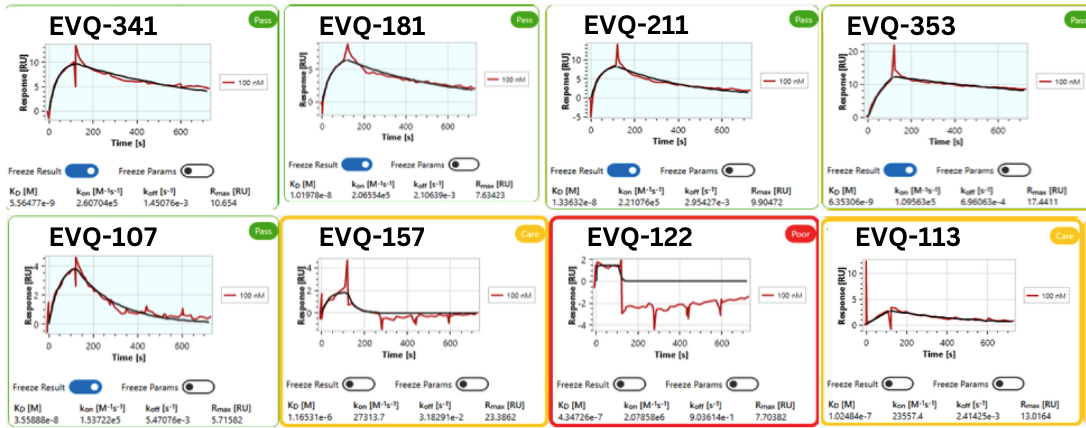
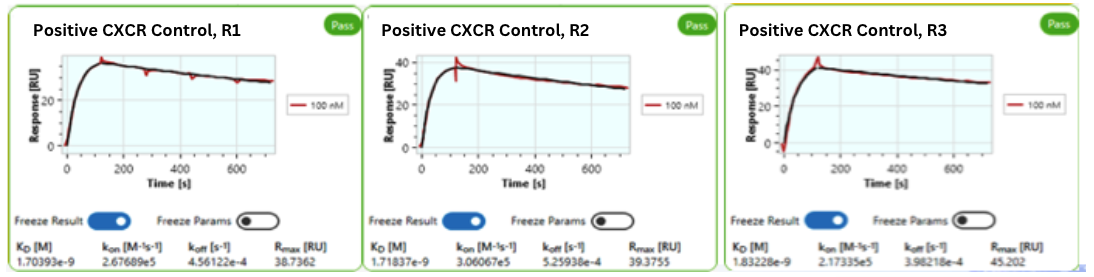
Measured response (red) with the fitted 1:1 model (black) at 100 nM analyte, and the derived constants per candidate. Top: the eight scored round-3 candidates, with the same Pass / Caution / Poor calls tabulated above. Bottom: the positive CXCR control, run once per round, reproducing to within 7.3% (1.70–1.83 nM). From Dell’uomo et al. [1].
Figure A3 · From in silico screen to measured hits
Figure A3. The 11 of 96 round-1 constructs with inclusion bodies or aggregation stay inside the round-1 denominator; round-2 expression data is not available. The best candidate (0.84 nM) was confirmed in follow-up characterization and is not plotted here.
A2
Methods
Expression. gBlocks (IDT) cloned into pTT5 (NRC Canada); transient transfection into HEK293-6E with PEI MAX (Polysciences) at 1:3 DNA:PEI; 37 °C, 8% CO₂, FreeStyle 293 medium, 7 days; Protein A purification (MabSelect SuRe); SEC; >95% purity by SDS-PAGE, reducing and non-reducing.
SPR. Biacore 8K (Cytiva); scFv captured via anti-His antibody; chemokine receptor extracellular domain; seven analyte concentrations, 0.78–200 nM.
Expression outcomes. Round 1: 88% predominant monomeric peaks (n = 96), 11 of 96 with inclusion bodies or aggregation. Round-2 data is unavailable and has not been interpolated. Round 3: near 100%. Model accuracy rose from 0.65 to 0.85 across the three rounds.
Not stated in the source record. Sensor chip, running buffer, temperature, flow rate, regeneration conditions, fit model, replicate count and double referencing: not in the published record, so not reproduced here. Full methods under CDA.
A3
Where these numbers sit
Against published work. Hit rates for computational antibody design cluster between 9% and 28% of designs tested [4]; Chai-2 reports 16% zero-shot across 52 targets, one round, ≤ 20 designs each [3]. Our per-round rates, 9% (3/32) and 17% (2/12) at one round and 21% (20/96) at round 3, sit in that range.
Traditional context [4]. Target-to-IND runs 18–24 months; phage panning to a characterized panel 6–8 weeks, screening 10¹⁰–10¹² variants over 8–12 rounds, against 288 sequences in 3 rounds here. Panels run from 12 designs to library-scale deliveries of up to 10⁶ sequences.
A4 · What we do not claim
No time to data or campaign duration: the wet-lab work is not ours and we do not quote timelines out of our control. In silico epitope engagement and specificity do not substitute for bench confirmation, and library-level liability exclusion reduces developability risk without removing it.
A5 · IP and data handling
Designs belong to the client; client inputs never train shared models and data is segregated between projects (abtique.com/terms-of-service). You or your CRO retain control over assay design and execution. Client identities are anonymized by policy. Named institutions appear with permission.
A6 · Glossary
KD equilibrium dissociation constant, koff/kon; lower is tighter. kon association rate, M⁻¹s⁻¹. koff dissociation rate, s⁻¹. scFv single-chain variable fragment. VHH camelid single-domain antibody. VHH-Fc VHH with an Fc domain. BiTE bispecific T-cell engager. SPR surface plasmon resonance.
References [1] Dell’uomo D, Satz A, Averso B. “HyperBind2: Multi-Shot Learning Enables Progressive Improvement in Computational Antibody Discovery.” bioRxiv 2025.11.06.687005, 11 November 2025. doi:10.1101/2025.11.06.687005. Preprint, not peer reviewed. · [2] HyperBind2 source code, GPL-3.0: github.com/baverso/HyperBind2-OpenSource · [3] Chai Discovery Team. “Zero-shot antibody design in a 24-well plate.” bioRxiv 2025.07.05.663018. Preprint. · [4] Traditional-workflow timings and variant counts are commonly reported industry ranges, not values we measured.